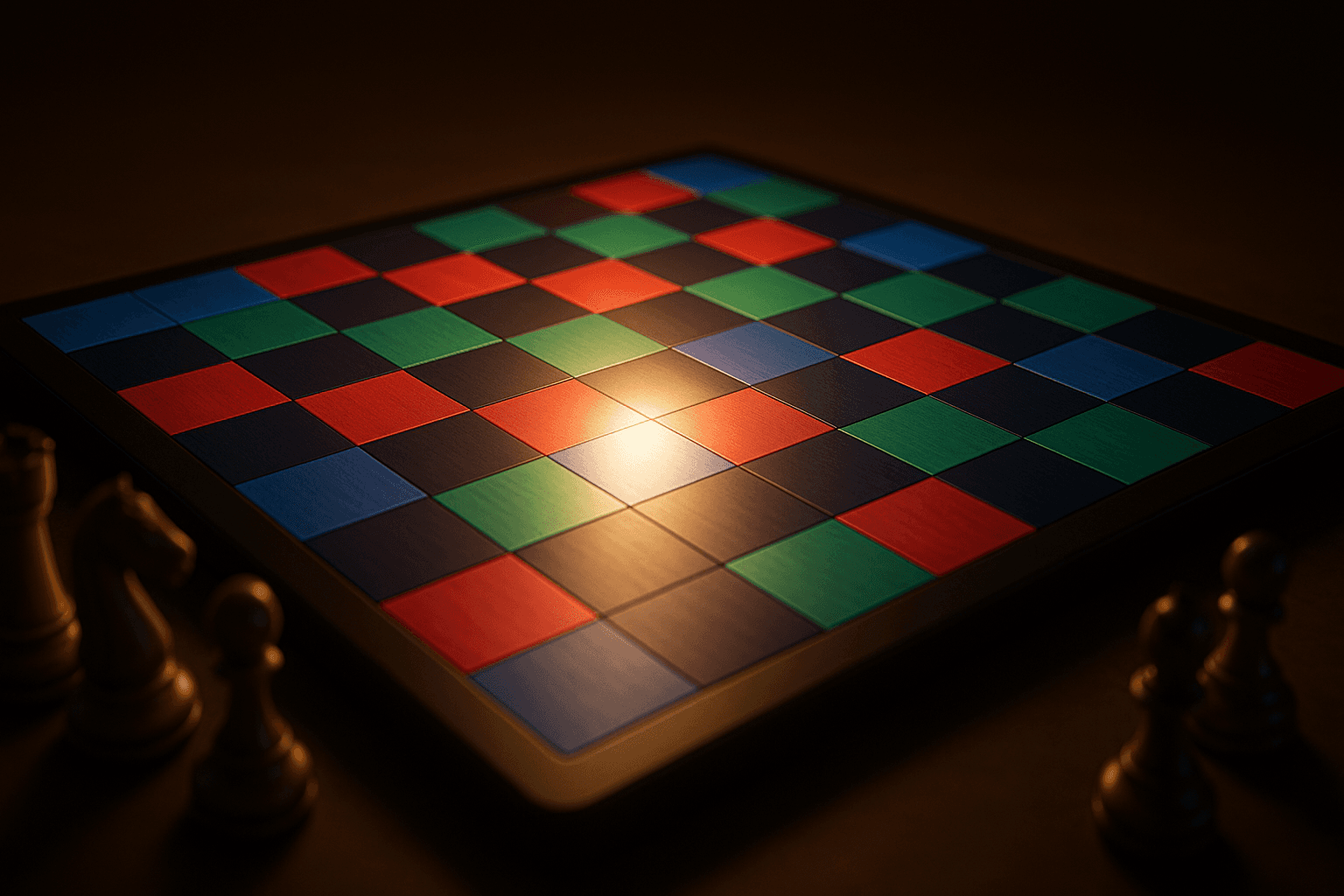
Board Check
Test every sensor and every light
The factory self-test. Sweeps all 64 LEDs, then waits for you to touch every square so you can confirm nothing is dead before you start a game.
How it plays
- 1
The board sweeps all 64 LEDs through white, red, green, and blue, then one pixel at a time.
- 2
Every square glows dim blue until a piece has been placed on it, then turns green.
- 3
The Connect page shows the count as you go and reports when all 64 sensors are confirmed.
- 4
It plays every sound the board knows, then sweeps the buzzer from 300 Hz to 2 kHz.
- 5
Button A repeats the LED sweep; button B restarts the sensor test. The battery gauge runs on rank 1.
What the lights do
A full-board colour sweep and a single-pixel chase, then dim blue on every unconfirmed square, white where a piece is right now, green once a sensor has registered. A rainbow when all 64 are done.
What you'll hear
Every effect in the library plays in turn, named on the Connect page as you hear it, followed by a rising sweep that catches a buzzer only resonating at one pitch. A fanfare when all 64 sensors pass.
What you need
- One board
Runs on
Open Chess Board · ESP32-S3
Built by Concept Bytes · based on board_test.ino · on OpenChessCore 1.0.0
More arcade

Checking your browser…
Make it yours
The Code tab has the whole game — 154 lines of rules, colours, and animations. Everything about the hardware lives in OpenChessCore, so that is all you need to read.
To upload your own version from Arduino IDE, add OpenChessCore.zip as a library, install Adafruit NeoPixel, NimBLE-Arduino, and pick ESP32S3 Dev Module with USB CDC On Boot: Enabled.